

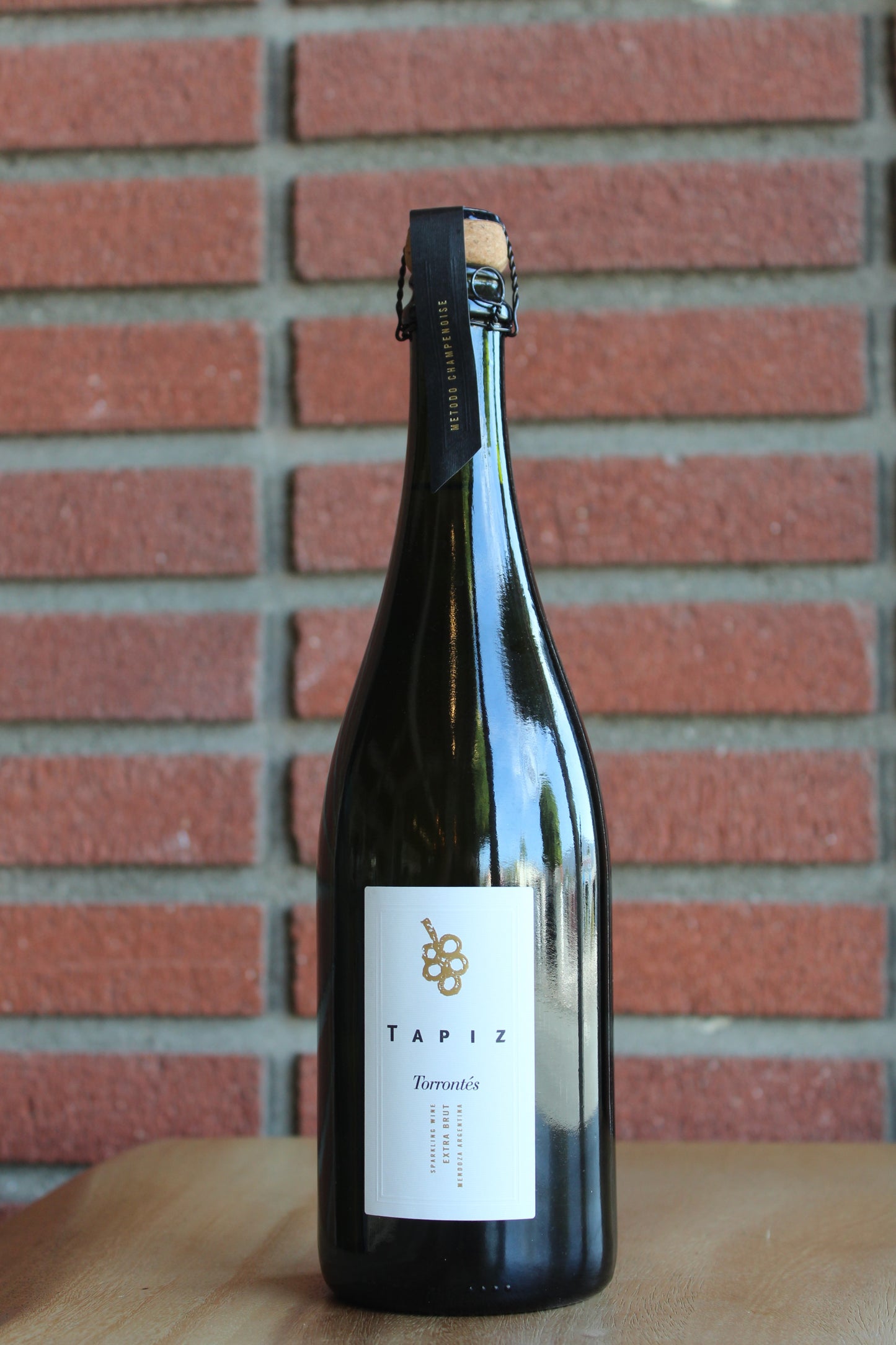
Bodegas Tapiz Sparkling Torrontés Extra Brut NV
Bodegas Tapiz Sparkling Torrontés Extra Brut NV
Mendoza, Argentina
Couldn't load pickup availability
Share
-
Tasting Notes
True to its varietal roots, this sparkling wine opens with a gorgeously aromatic, perfumed muskiness packed with lush white peach, bright tangerine, white flowers, and star jasmine. Don’t judge this book by its cover, though; the nose pulls a fast one on you. It sets you up to expect something sweet, but on the first sip, it delivers an ultra-refreshing, bone-dry profile defined by an almost saline minerality. Because of its extended time aging on the lees, the body carries a beautiful, rounded weight that feels incredibly balanced, driven by a mouthwatering, medium-plus acidity. It leaves a crisp slap of citrus zest and a vibrant hint of tropical pineapple on the lingering finish.
This traditional-method sparkling wine acts as a perfect structural bridge between two distinct culinary worlds: vibrant, aromatic Asian fusion and crispy, rich seafood. Because the nose delivers the deceptively sweet, exotic perfume of Torrontés while the palate slaps back with an electric, bone-dry acidity and fine effervescence, it thrives alongside fragrant dishes like Thai green curry, green papaya salad, sushi, and dim sum, where its citrusy top notes complement complex herbs and balance chili heat. Simultaneously, the precise, método champenoise bubble structure cuts effortlessly through the rich fats of fried appetizers—making it an exceptional partner for crispy calamari, spring rolls, and tempura-fried asparagus—while its natural lime-peel and chalky mineral profile plays the perfect seasoning agent for fresh Peruvian ceviche, oysters, or traditional Argentine chicken empanadas. -
Story
The story of Bodegas Tapiz began in 2002 when Patricia Ortiz, a former physician specializing in nephrology, and her husband Jorge acquired the Argentinian operations of California’s Kendall-Jackson. Motivated by a profound appreciation for Mendoza’s landscape, Patricia transitioned from medicine to viticulture with a vision of establishing a family estate focused on precision, regional expression, and social responsibility. As one of the most influential figures in modern Argentine wine—and the first female president of the Bodegas de Argentina wine chamber—Patricia has spent over two decades elevating her region's reputation while actively empowering the local community.
At the heart of the winery’s identity is an unwavering commitment to certified sustainability, which Patricia views as a holistic duty rather than a trend. Tapiz operates on a 100% cyclical agricultural model, recycling all grape skins and stems into biocompost and managing a strict water conservation system in Mendoza’s arid climate. Their commitment extends deeply into the social fabric of the region; the estate maintains a herd of llamas whose wool is provided to local artisans, preserving traditional weaving techniques and supporting the community. For Tapiz, creating exceptional wine is fundamentally tied to protecting the land and honoring the people who work it.
What truly sets the winery apart on the global stage is a rare meeting of minds that bridges the New and Old Worlds. Head winemaker Fabián Valenzuela, who brings decades of intimate local terroir knowledge, works in exclusive collaboration with consulting oenologist Jean-Claude Berrouet. Renowned for overseeing 44 historic vintages at Bordeaux’s iconic Château Petrus, Berrouet joined the Tapiz team in 2012. This partnership infuses traditional Argentine varietals with a signature Bordeaux-style restraint, elegance, and structural balance, resulting in a portfolio that offers a sophisticated, world-class expression of Mendoza.
-
Somm Notes
Unlike the vast majority of international grapes grown across the Americas—such as Cabernet Sauvignon or Chardonnay, which were brought over as cuttings from Europe—Torrontés is an authentic, indigenous New World creation. Born in South America during the colonial era, Torrontés is a natural genetic crossbreed of two ancestral varieties brought over by Spanish missionaries: Muscat of Alexandria and Criolla Chica (the latter known as Pais in Chile or Mission in the United States).
Because it adapted perfectly to the specific, sun-drenched, high-altitude landscapes of the Southern Hemisphere, it is grown almost nowhere else on Earth. Argentina holds a near-monopoly on the grape, claiming roughly 95% of the world’s true Torrontés acreage, cementing it as the nation's definitive signature white wine.
Physically, Torrontés is defined by relatively large, thin-skinned grapes that accumulate high sugars while losing natural acidity rapidly if allowed to sit in warm climates. Its Muscat parentage grants it an incredibly loud, intensely aromatic "perfumed" fingerprint.
To the senses, a typical Torrontés offers an olfactory illusion: it smells intensely sweet, throwing off powerful aromas of white peach, orange blossom, jasmine, rose petals, and exotic lychee. However, on the palate, a well-made version delivers a complete contrast—finishing entirely bone-dry, light-to-medium-bodied, with a refreshing, slightly bitter citrus-peel and chalky mineral edge.
Unlike famous European imports like Malbec or Chardonnay, Torrontés is an authentic, indigenous New World creation. Born in South America during the colonial era, it is a natural genetic crossbreed of Muscat of Alexandria and Criolla Chica. Because it adapted perfectly to the high-altitude landscapes of the Southern Hemisphere, it is grown almost nowhere else on Earth. Argentina holds a near-monopoly, claiming roughly 95% of the world’s true Torrontés acreage. While neighboring Chile has small plantings of the identical grape, they rarely bottle it as a varietal wine, historically defaulting to calling it Torrontel and distilling it immediately into Pisco brandy.
It is also critical to look past the label when it comes to European lookalikes. If you pick up a bottle called "Torrontés" from Galicia, Spain, or encounter it as a local blending synonym in Portugal, you are drinking entirely separate, unrelated grape vines. True Torrontés belongs solely to South America, physically defined by thin skins that pack a massive aromatic punch. The parentage of Muscat grants the grape an incredible sensory trick: the nose smells intensely sweet—throwing off explosive aromas of white peach, orange blossom, and jasmine—yet the palate slaps back with a completely bone-dry, light-bodied, and refreshing citrus-peel finish.
Turning a highly aromatic, low-acid grape like Torrontés into a sparkling wine is a massive technical gamble. Usually, when winemakers play with aromatic grapes, they rush them through large, industrial steel tanks via the Charmat method to make simple, frothy, off-dry bubbles. Bodegas Tapiz completely shatters this norm, producing what is recognized as the only Método Champenoise (Traditional Method) Sparkling Torrontés in the world. Harvested from their sustainably farmed El Jarillal Estate in Alto Agrelo, Mendoza, the fruit relies on intense high-altitude sunshine and crisp mountain nights to lock in a striking spine of natural acidity before undergoing secondary fermentation entirely inside the individual bottle.
This heavy investment of labor and time pays off beautifully in the glass. Instead of an aggressive, frothy mousse, the traditional method forces the carbon dioxide to dissolve perfectly into the liquid, producing an incredibly fine, persistent bead of tiny bubbles. More importantly, the extended time the wine spends interacting with the yeast inside the bottle reins in the grape's wild, overly perfume-heavy impulses. It seamlessly integrates the iconic, exuberant floral aromas into a sophisticated, beautifully structured Extra Brut frame, delivering an electric shock of chalky minerality and mouthwatering crispness.
Vinous (Joaquín Hidalgo): 90 Points > "Lauded for its delicate floral and citrus nose, fine persistent bubbles, and an elegant, crisp finish that beautifully highlights its unique varietal origin." -
Region
Mendoza stands as the undisputed heart of Argentine winemaking, responsible for roughly 75% of the country’s total vineyard acreage. Situated in the rain shadow of the towering Andes Mountains, this high-altitude desert region is defined by its arid climate, intense solar radiation, and clean, snowmelt-driven irrigation. The combination of brilliant, unfiltered sunlight and cool mountain nights allows grapes to achieve optimal ripeness while maintaining vibrant health. Within this sprawling viticultural landscape, micro-regions vary drastically by altitude and soil composition, allowing producers to masterfully blend fruit from distinctly different terroirs to achieve ultimate balance.Further down in the traditional "First Zone" of Luján de Cuyo sits Agrelo, a lower-altitude benchland resting at roughly 3,100 feet above sea level. This historic sub-region is characterized by deep, clay-dominant alluvial soils that retain moisture better than the rockier areas of Mendoza. The slightly warmer climate of Agrelo yields grapes with incredible aromatic richness and generous, plush fruit flavors. It is a region celebrated for providing weight, texture, and a highly expressive, aromatic concentration to the grapes grown in its soil.In sharp contrast to the flats of Agrelo lies the Uco Valley, a dramatic, high-altitude frontier creeping up into the very foothills of the Andes, where Tapiz's estate vineyards soar up to 4,600 feet. Here, the terroir shifts to poor, stony, gravel-rich soils heavily laced with calcium carbonate (limestone). At this extreme elevation, the diurnal temperature swing can exceed 40°F in a single day. This biting alpine cold slows down the ripening process, preserving piercing, electric natural acidity and infusing the grapes with a distinct, chalky minerality. When crafting a sparkling Torrontés, balancing these two contrasting terroirs is nothing short of essential. Torrontés is a highly expressive, intensely aromatic indigenous grape that can easily become over-ripe, heavy, or low in acid if grown entirely in warm plains. By combining the lush, fragrant floral and citrus character of Agrelo with the taut, mineral-driven, high-altitude acidity of the Uco Valley, Tapiz achieves a brilliant equilibrium. The result is a sparkling wine that preserves the grape's iconic, exuberant aromatic identity while delivering a crisp, precise, and structural freshness on the palate.