

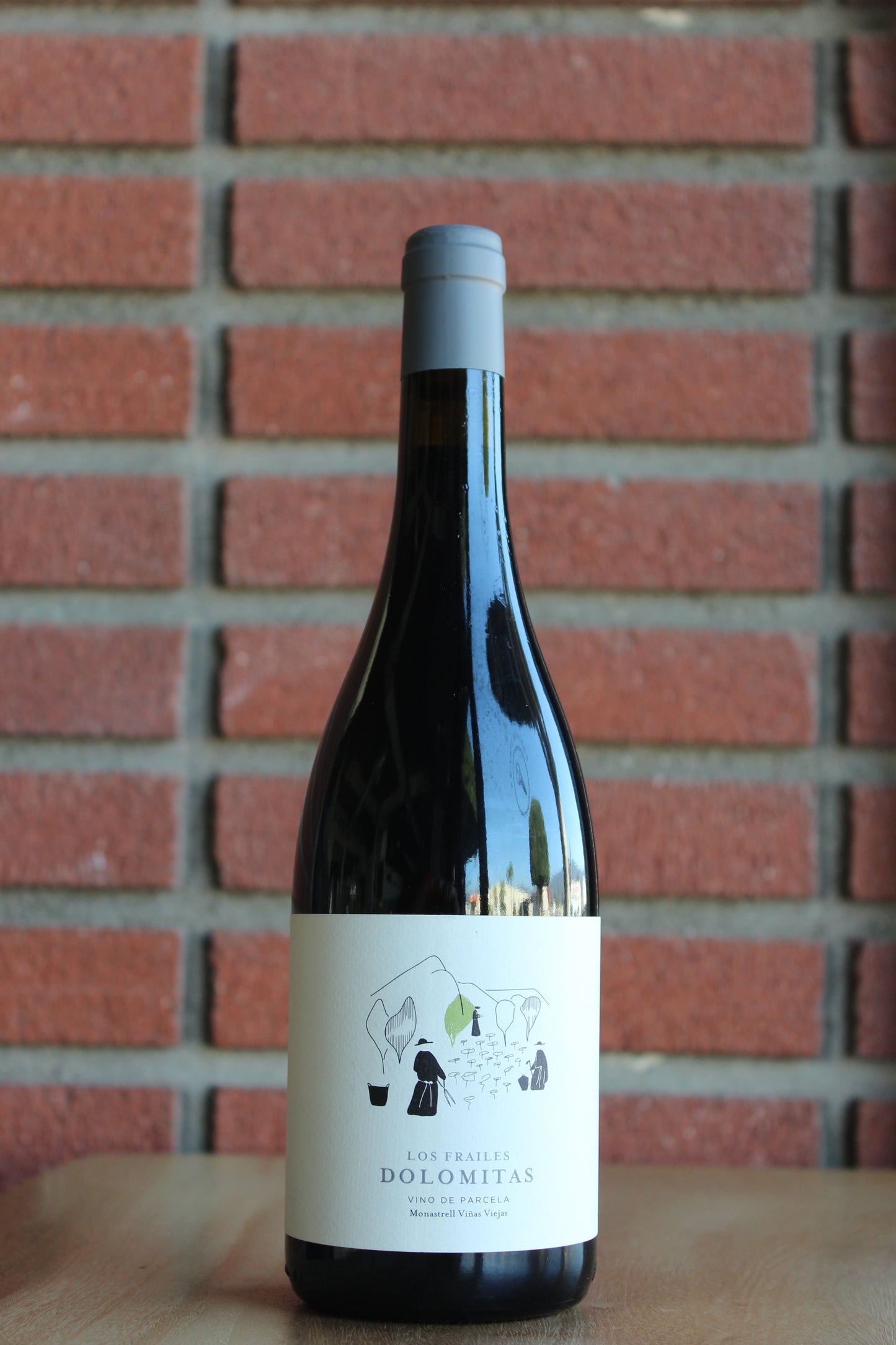
Casa Los Frailes "Dolomitas" Monastrell 2021
Casa Los Frailes "Dolomitas" Monastrell 2021
Vall dels Alfornis, Valencia, Spain
Couldn't load pickup availability
Share
-
Tasting Notes
The 2021 “Dolomita” Monastrell captures the wild beauty of the Vall dels Alforins in liquid form — pure, lifted, and full of Mediterranean character. Grown at roughly 2,000 feet above sea level on limestone and scree soils cascading down from the Dolomita mountain range, the fruit reflects the energy of its high-altitude, calcareous environment.
On the nose, the wine opens with dark plum, blackberry, and cocoa dust, interwoven with aromas of bay leaf, wild herbs, and stony minerality. These savory accents nod to the surrounding Mediterranean scrub and the minimal-intervention approach taken in the cellar.
Fermented and aged for 10 months in concrete vats and clay amphorae, Dolomita retains remarkable freshness and purity of fruit. The absence of oak influence allows Monastrell’s natural brightness and tension to shine — juicy red and black fruit framed by fine, chalky tannins. The palate is medium to full-bodied, but there’s a buoyancy to its texture, a lively interplay of fruit and earth that speaks to the vineyard’s altitude and the cooling breezes funneled through the valley.
The finish lingers with a subtle herbaceous lift — bay, thyme, and lavender — balanced by ripe plum and a whisper of cocoa, evoking the sun-warmed soils and surrounding flora.
This is Monastrell in its most elegant, terroir-driven form: fresh, savory, and alive, showing the harmony between site, soil, and the restrained hand of the winemaker. -
Story
The story of Casa Los Frailes begins in 1771, when the estate was owned and cultivated by Jesuit friars who recognized the land’s extraordinary potential for grape growing. As was common across Europe at the time, religious orders played a pivotal role in advancing viticulture — selecting vineyard sites, perfecting cellar techniques, and preserving local grape varieties that might have otherwise been lost. The friars’ knowledge and stewardship left an indelible mark on the landscape of the Vall dels Alforins, a high-elevation valley inland from Valencia, where vines, olive groves, and Mediterranean forest coexist in harmony.
When the Jesuits were expelled from Spain in the late 18th century, the property was sold at public auction and purchased by the Velázquez family — the same family that continues to farm it today. Now in the 13th generation, the family has carried forward the friars’ spirit of care and respect for the land, balancing heritage with innovation.
Centuries later, that reverence still guides every decision at Casa Los Frailes. The estate was one of the first in Spain to be certified organic (2000) and later adopted biodynamic farming, aligning perfectly with the founders’ principles of harmony between nature and craftsmanship. Vines are dry-farmed, planted in bush form (gobelet), and rooted in limestone-rich soils that force them deep underground — a natural way of nurturing resilience and concentration in the grapes.
In the cellar, the family honors traditional methods with a modern sensibility. Fermentation takes place in concrete vats and clay amphorae built into the original Jesuit cellar, preserving freshness and purity. Oak is used with restraint, allowing the fruit and terroir to shine through.
Today, Casa Los Frailes stands as a living bridge between past and present — a winery where history, sustainability, and craftsmanship converge. Each wine, including Dolomita Monastrell, reflects the centuries-old philosophy that great wines are born not only from the land, but from those who have cared for it across generations.
-
Somm Notes
Monastrell — known as Mourvèdre in France and Mataro in parts of the New World — is one of the Mediterranean’s great survivor grapes. It’s thick-skinned, late-ripening, and naturally low-yielding, making it ideally suited to hot, arid environments where many other varieties struggle. Its physiology tells the story of its resilience: small, densely pigmented berries produce deeply colored wines with firm tannins and concentrated flavors, while the grape’s thick skins protect it from the intense sun and help retain acidity even under extreme heat.
Monastrell thrives in warm, dry climates with limestone or calcareous soils, where good drainage forces the vines to send roots deep underground. The result is fruit with powerful structure, ripe fruit concentration, and a signature earthy-mineral edge. In cooler sites or higher altitudes — like the Vall dels Alforins, where Dolomita is grown — the grape develops a fresher profile, showing more red fruit, floral, and herbal notes alongside its natural depth and spice.
Winemaking styles for Monastrell vary widely, reflecting both terroir and philosophy. In southern France (Bandol), it’s often structured and long-lived, aged extensively in oak to tame its tannins. In Jumilla and Yecla, styles can range from rustic and robust to polished and modern, depending on oak use and harvest timing. Increasingly, producers like Casa Los Frailes are choosing to highlight Monastrell’s elegant side through minimal intervention and aging in concrete and amphora, which soften tannins naturally while preserving freshness and purity.
Monastrell has also long been prized as a blending grape, often combined with Grenache (Garnacha) and Syrah — a trio celebrated in both France and Spain for balancing fruit, spice, and structure. In blends, Monastrell contributes depth, color, and longevity. However, single-varietal Monastrell wines, while less common, are the truest expression of its character: bold yet refined, simultaneously rustic and sophisticated. Dolomita Monastrell 2021 belongs to this latter camp — an honest, terroir-driven rendition that celebrates the grape’s natural balance between strength and elegance.
Casa Los Frailes’ choice to ferment and age Dolomita entirely in concrete vats and clay amphorae underscores this approach. Both materials are porous, allowing micro-oxygenation that softens tannins without introducing oak flavor. Concrete enhances texture and mineral definition, while amphora preserves brightness and aromatics, amplifying the connection between grape and ground. The result is a Monastrell that’s fresh, herbaceous, and savory — a pure reflection of its limestone soil and high-altitude origin.
On the table, Dolomita’s mix of fruit, herbs, and gentle structure makes it incredibly versatile. Try it with grilled lamb chops rubbed with rosemary, smoky eggplant and lentil stew, paella with roasted vegetables, or aged Manchego and Iberico ham. It’s a wine that bridges rustic Mediterranean roots with modern finesse — Monastrell at its most expressive and honest. -
Region
Spain’s eastern coast, along the Mediterranean, is home to the Valencia wine region — a landscape shaped by sunshine, limestone, and centuries of winemaking tradition. The area’s diverse terrain stretches from sea-level plains to mountain plateaus reaching over 700 meters, offering a range of microclimates ideal for grape growing. Warm, dry days and cool nights allow fruit to ripen fully while preserving acidity, a balance that defines the region’s vibrant, aromatic wines.
The region’s long viticultural history dates back to the Phoenicians and Romans, but it was the religious orders — including Jesuit and Cistercian friars — who refined vineyard management and cellar practices throughout the Middle Ages. They identified the best soils, understood natural fermentation, and preserved native grapes such as Monastrell, Bobal, and Verdil.
Within the broader Valencian area lies Jumilla, an inland subregion that straddles the border of Valencia and Murcia. Jumilla is defined by its semi-arid climate, intense summer heat, and limestone-rich soils that provide excellent drainage while forcing vines to dig deep for water. These conditions create naturally low yields and concentrated grapes — hallmarks of Jumilla’s bold, deeply colored red wines. Despite its rugged environment, Jumilla’s vineyards are remarkably resilient; the region’s sandy and limestone soils even helped protect many of its vines from the phylloxera epidemic that devastated Europe in the 19th century.
Just north of Jumilla lies Vall dels Alforins, often described as the “Tuscany of Valencia.” This elevated inland valley, nestled between mountain ranges, combines Mediterranean sunshine with the cooling influence of altitude and breezes from the sea. The result is a distinctive terroir — warm enough for ripeness, yet fresh enough for balance. Soils here are highly calcareous and stony, naturally poor in organic matter, which encourages deep root systems and intensifies the mineral expression in the wines.
It’s no surprise that Monastrell (known as Mourvèdre in France) thrives here. The grape is perfectly suited to the region’s challenging conditions — tolerant of drought, resistant to heat, and capable of producing wines with remarkable depth and longevity. In these limestone-dominant soils, Monastrell reveals a distinct profile: dark fruit, Mediterranean herbs, earth, and minerality, wrapped in firm but elegant tannins. Alongside it, varieties like Garnacha, Syrah, and Cabernet Sauvignon add dimension to the regional wine scene, but Monastrell remains its beating heart — a grape that connects ancient tradition with modern sustainability