

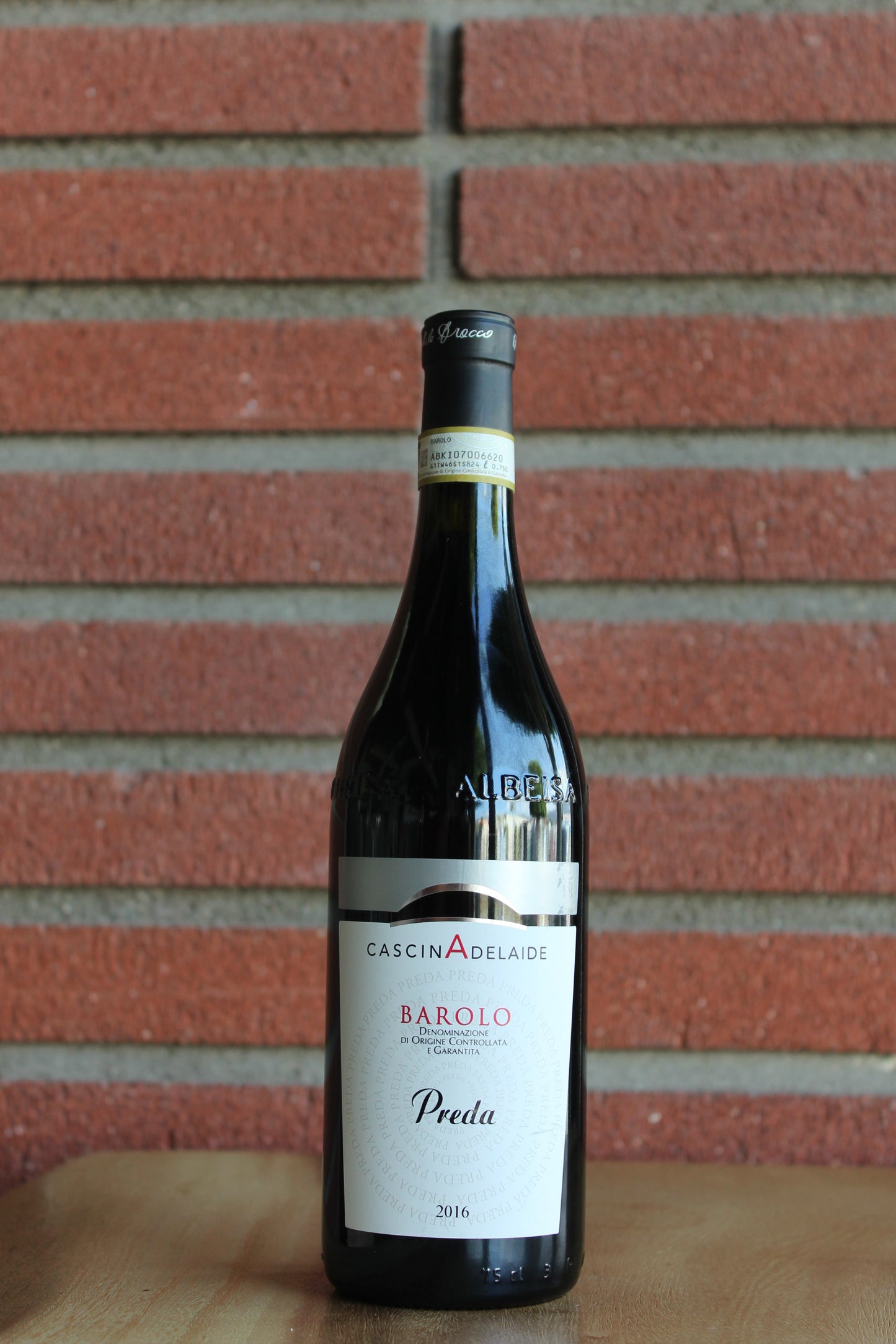
Cascina Adelaide "Preda" Barolo 2016
Cascina Adelaide "Preda" Barolo 2016
Barolo, Piedmont, Italy
Couldn't load pickup availability
Share
-
Tasting Notes
Deep garnet in color, the 2016 Preda Barolo boasts a nose of ripe plum and mulberry spills into deeper layers of wild blueberry and cinnamon, while aromas of menthol and herbs give it a fresh cooling character. The palate is full-bodied yet refined—velvety tannins and structured acidity and echoes the flavors of plum, wild blueberry, cherry, liquorice, blood orange, cedar, and subtle spice, all framing a long, savory finish. The wine’s character reflects its site: marl and sandy soil lend an earthy precision.
-
Story
Founded in 1999 by Amabile Drocco, Cascina Adelaide is a modern Barolo estate with deep respect for tradition. After a career in Alba’s mechanical industry, Drocco returned to his family’s farming roots and built a striking gravity-fed cellar in the heart of the village of Barolo. His vision was clear: to let each vineyard speak for itself.
Today, Cascina Adelaide farms prime holdings across the region’s most prestigious crus—including Cannubi, Preda, Fossati, Costa Fiore, Pernici, and Bussia—crafting single-vineyard Barolos that highlight the nuances of terroir. All vineyard work is done by hand, without herbicides, using cover crops and natural fertilization. In the cellar, grapes ferment slowly with native yeasts and minimal sulfur before aging about two years in large neutral French oak barrels and at least 12 months in bottle.
Critically acclaimed by guides like Decanter and Falstaff, Cascina Adelaide has earned a reputation for precision, elegance, and expressive Barolos that balance modern technique with authentic character.
-
Somm Notes
Nebbiolo is the red grape that defines Barolo—and it’s no ordinary variety. Thin-skinned and lightly colored, it delivers intense structure and high acidity, building deeply layered wines that reward patience. In youth, expect fresh notes like cherries, raspberries, tar, and roses; as Nebbiolo ages, it evolves into intoxicating aromas of violets, truffles, leather, wild herbs—and that signature brick-orange hue at the rim. These wines are built for the long haul.
Why Barolo Is Called the “King of Wines”
Barolo earned its royal nickname both for its regal qualities and its storied history. In the 19th century, Italian nobility—like King Charles Albert and Count Cavour—fell in love with this powerful wine, dubbing it the “wine of kings.” Over time, it became known as “the king of wines” not just for its power and pedigree but also for the elegance and complexity that emerge over decades in the bottle.
The 2016 Barolo vintage stands out as one of the most exceptional in recent memory, earning widespread acclaim from critics and producers alike. Kerin O'Keefe, renowned wine critic and author, describes the 2016 Barolos as "fresh, fragrant and loaded with finesse," highlighting their bright red berry fruit, vibrant acidity, and refined tannins. She notes that the extended growing season allowed for perfect conditions for the delicate Nebbiolo grape, resulting in wines that showcase the unique expressions of various vineyards .
In comparison to the 2015 vintage, which was marked by a hot and dry growing season leading to wines with higher alcohol and softer acidity, the 2016s offer more balance and elegance. The 2017 vintage, while also producing elegant wines, faced challenges due to heat and drought, leading to wines with slightly less freshness and structure
The 2016 Barolos are expected to have excellent aging potential, with many critics suggesting they will continue to evolve beautifully over the next two decades. This vintage is considered a benchmark for quality, offering wines that are both approachable in their youth and capable of developing complex flavors with age.
Braised meats – Think osso buco, beef stew, or lamb shanks; the wine’s structure meets their richness perfectly.
Truffle-forward dishes – Whether it’s tajarin with butter and white truffles or a truffle risotto, their earthiness elevates Barolo’s complex aromatics.
Hearty pasta & mushrooms – Fettuccine or tagliatelle with rich ragù or porcini mushrooms turn cozy wine into a cozy experience.
Aged cheeses – Parmigiano-Reggiano or robust sheep’s cheese play off the wine’s tannins and savory depth. -
Region
In the Langhe hills of Piedmont, Barolo spans just 11 villages—five of which (Barolo, La Morra, Castiglione Falletto, Monforte d’Alba, and Serralunga d’Alba) account for nearly 90% of its production. This compact region is defined by steep slopes, dramatic terroir variations, and a continental climate moderated by the Tanaro River—where significant day-night swings and cooler temps nurture the late-ripening, finicky Nebbiolo grape to full expression.
Barolo’s diverse soils—from mineral-rich calcareous marl in the west to more austere sandstone in the east—result in a spectrum of wine styles. Western zones like La Morra and Barolo yield elegant, perfumed wines with softer tannins and earlier approachability. In contrast, eastern areas such as Serralunga and Monforte d’Alba produce deeply structured, tannic wines that can require decades to soften and reveal their full depth.
The region’s classification is rooted in terroir specificity—Barolo has embraced a “cru” system with over 181 formally recognized Menzioni Geografiche Aggiuntive (MGAs)—a Burgundian-like approach emphasizing vineyard identity.
The “Preda” Vineyard: A Unique Expression
Within this intricate patchwork of soils and microclimates lies the Preda vineyard—one of Cascina Adelaide’s prized sites. Though less documented in popular literature, Preda is typically characterized by its white clay and sandy soils and western exposure, lending it a distinct profile that balances freshness, ripeness, and texture. Wines from Preda often display a nuanced aromatic lift, nuanced structure, and a brightness in mid-palate that reflects both the broader Barolo terroir and the site’s individual nuance