

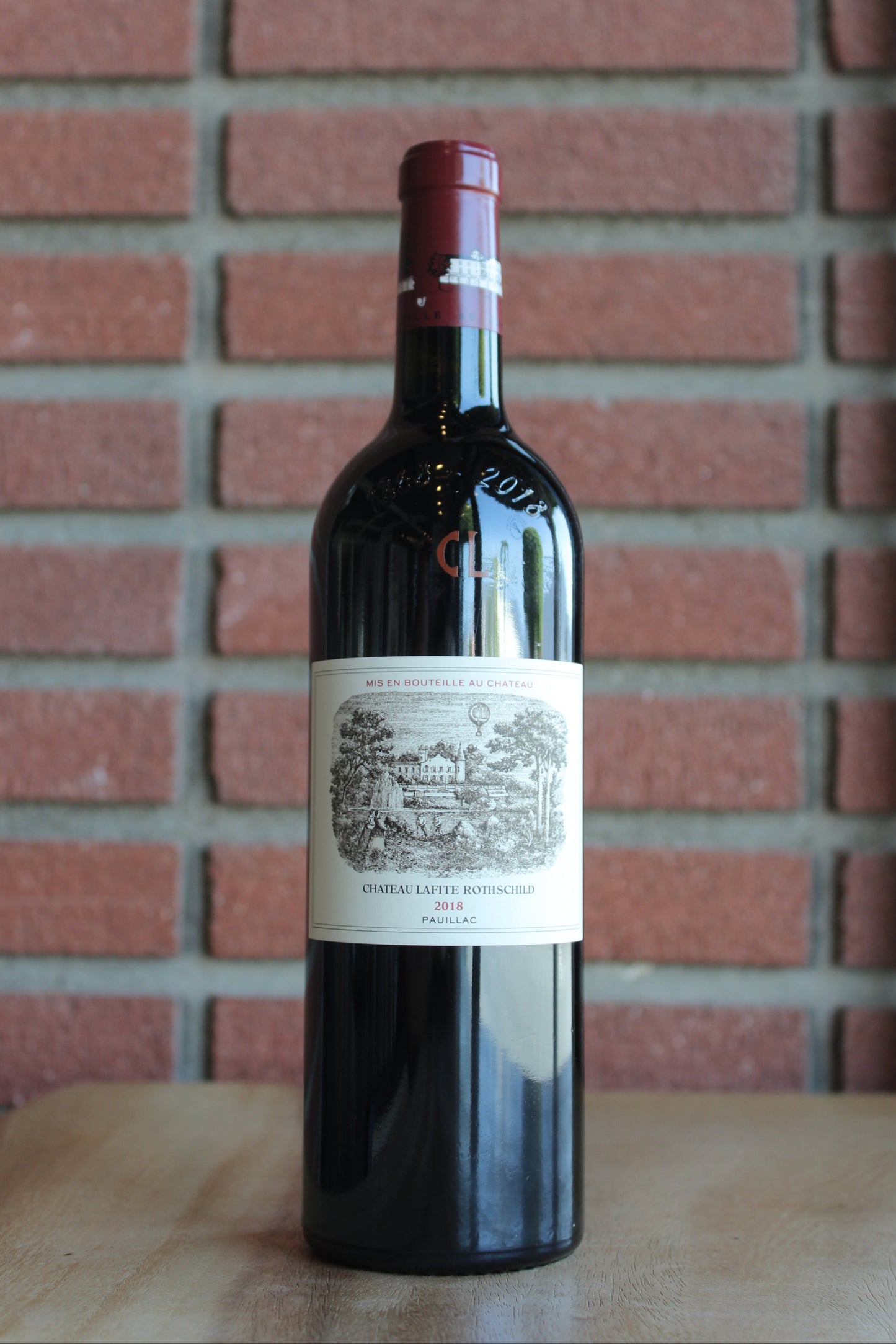
2018 Château Lafite Rothschild Pauillac Premier Grand Cru Classé
2018 Château Lafite Rothschild Pauillac Premier Grand Cru Classé
Pauillac AOP, Bordeaux, France
Couldn't load pickup availability
Share
-
Tasting Notes
The 2018 vintage at Lafite presents a masterclass in weightless authority, achieving remarkable technical balance despite a warm growing season. Anchored by an exceptionally high 91% Cabernet Sauvignon ratio (supported by 8.5% Merlot and 0.5% Petit Verdot), the wine sits at a classic 13.3% ABV with a vibrant 3.75 pH. Rather than leading with simple, sun-baked fruit, the nose requires a few moments to unlock tightly coiled aromatics of blackcurrant cordial, bilberry, and dark plum compote, deeply interwoven with non-fruit complexities of lead-pencil shavings, cedar chest, crushed iron ore, and a distinct eucalyptus-mint lift.
On the palate, the wine showcases an extraordinary polyphenol density (IPT 74) that remains effortlessly fluid rather than heavy or aggressive. The extraction is remarkably fine-grained; the tannins feel pixelated, seamlessly polished, and completely wrapped in fruit extract. Guided by its bright natural acidity, a firm mineral spine cuts through the mid-palate, giving the rich dark fruit vertical energy and preventing any heavy oak imprint from its 15 to 20 months in 100% new French oak barrels.
The finish is extraordinarily long and persistent, extending well past 60 seconds with lingering savory tones of sweet bay leaf, slate, and a faint saline edge. While approachable earlier than historical vintages due to the silky maturity of its tannins, the structural framework and acid preservation of the 2018 guarantee an immense cellaring trajectory. Expect primary fruit to transition into secondary and tertiary complexity—truffle, cigar box, and forest floor—with peak maturity spanning 2035 through 2060+.
-
Story
Château Lafite Rothschild: The King’s Wine
Long before it became an international benchmark for fine wine, Lafite was rooted in the elevated, gravel plateau of northern Pauillac—taking its name from the Gascon term la hite, meaning "the hillock." While records mention the medieval fiefdom as early as 1234, the estate’s true winemaking legacy began in the 1670s when Jacques de Ségur recognized the extraordinary potential of its soil and systematically planted the property’s core vineyards.
Royal Courts & Early Admirers
It was Jacques’ heir, Nicolas-Alexandre, Marquis de Ségur, who elevated Lafite to historic heights. Dubbed the "Wine Prince" by King Louis XV, the Marquis introduced the estate's bottles to Versailles, where it quickly captured the French royal court and earned its legendary moniker: "The King's Wine." Word of Lafite's exceptional quality spread rapidly across the globe; by 1787, Thomas Jefferson visited the estate, naming it among his favorite Left Bank châteaux and placing some of the earliest orders for North American cellars.
First Growth Supremacy & The Rothschild Era
Lafite’s stature was permanently etched into history at the 1855 Exposition Universelle in Paris. When Emperor Napoleon III requested a classification of Bordeaux’s finest red wines, Château Lafite was granted Premier Grand Cru Classé (First Growth) status—holding the coveted position at the very top of the original four First Growth estates.
Thirteen years later, on August 8, 1868, Baron James Mayer de Rothschild acquired the château at auction for a record 4.4 million gold francs. Though Baron James passed away just three months later, the estate remained firmly in family hands. Over the next century and a half, through world wars, economic depression, and agricultural crises, six generations of Rothschild stewardship have safeguarded Lafite’s legacy, establishing Domaines Barons de Rothschild as one of the most revered names in fine wine.
-
Somm Notes
As one of the historic "Big Five" Premier Grand Cru Classé estates established in the landmark 1855 Classification, Château Lafite Rothschild remains the quintessential collector’s First Growth. Its prestige is rooted in nearly eight centuries of history, yet its modern era is defined by dynamic stewardship. Led by Chairwoman and CEO Saskia de Rothschild—who became the youngest person and first woman to lead the estate at age 31—Lafite has paired centuries of tradition with progressive environmental leadership. The estate converted all 112 hectares to 100% certified organic viticulture and secured B Corp Certification across Domaines Barons de Rothschild, ensuring its legendary cellaring potential is built on regenerative soil health.
Cellaring & Longevity Expectations
The 2018 vintage combines a sunny, solar growing season with classic Left Bank structure, giving it an exceptionally long life ahead. During its early cellaring phase through 2028, the wine remains tightly wound and youthfully structured, dominated by primary graphite, dark berries, and integrated French oak. As it enters its peak drinking window between 2030 and 2065, the tannins soften into a seamless, velvety texture while primary fruit yields to profound secondary and tertiary complexity, including black truffle, cigar box, wet stone, and dried herbs. To preserve its trajectory, store the bottle horizontally at a constant 53 to 57 degrees Fahrenheit with 65 to 75 percent humidity, protected from direct light and vibration.
Decanting & Service Recommendations
If opening this young vintage prior to 2030, a generous decanting time of three to four hours is necessary to allow the dense tannic structure and tightly coiled aromatic core to uncoil. Once the wine reaches mature peak after 2035, decanting should be shortened to 45 to 60 minutes simply to separate natural sediment and allow gentle aeration. Serve at a temperate 60 to 65 degrees Fahrenheit to prevent warmth from elevating alcohol perception or masking the delicate eucalyptus-mint freshness. A classic, large-bowled Bordeaux glass is recommended to properly direct the wine to the back of the palate and capture its complex aromatics.
Pairing Suggestions
Given Lafite's classic, graphite-driven mineral core and fine-grained tannic tension, the wine excels alongside dishes rich in protein and natural fats that mirror its savory complexity. Traditional regional pairings include Agneau de Pauillac roasted with garlic and rosemary, or a dry-aged Côte de Bœuf finished with a classic Bordelaise reduction. For a more elevated culinary presentation, consider roasted squab with a dark berry glaze, pan-seared duck breast, or slow-braised beef cheeks served over truffled pomme purée. For cheese selections, choose firm, long-aged mountain varieties that match the wine's natural acidity without overpowering its finesse, such as 24 to 36-month aged Comté, aged Gouda, or Mimolette.
Critical Reviews:
100 – Robert Parker's Wine Advocate
The 2018 Lafite Rothschild is blended of 91% Cabernet Sauvignon, 8.5% Merlot and 0.5% Petit Verdot and has 13.3% alcohol. Deep purple-black in color, it needs a fair bit of swirling to unlock intoxicating scents of blackcurrant cordial, baked plums and black cherry compote with an undercurrent of dark chocolate, licorice, cast-iron pan, cedar chest and fertile loam, plus a waft of pencil lead. The delicately crafted, medium-bodied palate is dripping with class, featuring layers of mineral-laced black fruits and exquisitely ripe, singularly Lafite tannins, finishing with epic length and depth. This simply stunning, delicately crafted expression of 2018 with its singularly evocative imprint of Lafite will require a good 7-8 years in bottle, then should continue to inspire awe over the following 40+ years.
100 – Wine Enthusiast
An immensely structured wine, this is complex, concentrated and yet so contained. The wine impresses with its balance, layers of succulent black-currant fruits and effortless style. A wine for the long term, it should not be touched before 2029.
100 – The Wine Independent
The 2018 Lafite Rothschild is deep garnet-purple in color. It needs a little swirling to unlock notes of baked plums, boysenberry preserves, and crème de cassis, with touches of menthol, Indian spices and smoked meats. Medium to full-bodied, the palate delivers mouth-filling, spicy black fruits with velvety tannins and a long, energetic finish.
99 – James Suckling
Wow. The aromas are so intense and refined at the same time, offering gorgeous blackcurrant, lead-pencil and orchid character. Such purity of fruit. Sleek and finely polished with a fine cut to the tannins that provide such grace and glamor. Yet, it's got the power and structure to age for decades. On and on. Try after 2029.
98 – Decanter
This stood out during en primeur, not just for itself but also in comparison to so many estates around it. While several properties had an unusual vintage, where their personalities were subverted by the weather conditions, Lafite just continued being Lafite, a true mark of its character and its terroir. This is still of course extremely young, keeping its cards close to its chest; the power for now is hidden, waiting, and will slowly unveil. This is going to be a beautiful Lafite in the future, a brilliant wine with bilberry, slate and pencil lead character, and a eucalyptus mint wash. Drinking Window 2028 - 2050
98 – Vinous
The 2018 Lafite-Rothschild is a stunning wine. Silky and floral, the 2018 offers all the signatures of the Grand Vin, but amplified by the radiance of the year. In the glass, Lafite is rich and exotic, yet it also retains tremendous vibrancy. The interplay of Merlot picked early and Cabernet Sauvignon harvested late makes for wine of extraordinary dimension, complexity and class. Graphite, dark red fruit, spice and leather linger on the huge finish. Magnificent!
98 – Jeb Dunnuck
Checking in as a blend of 91% Cabernet Sauvignon, 8.5% Merlot, and the balance Petit Verdot, the 2018 Château Lafite-Rothschild is one of those magical Lafites that offers an already up-front, complex, nuanced style yet has the class and balance to evolve for 40-50 years. As always, this wine is never about sheer power, and the 2018 offers a full-bodied, incredibly elegant and weightless style that carries textbook blackcurrant fruits, lead pencil shavings, green tobacco, cedarwood, and camphor aromas and flavors. I compared this wine to a more elegant version of the 2016 from barrel and I think that comparison still holds. Incredibly up-front and charming, and already drinkable with sweet tannins, it will unquestionably pick up more complexity and nuance over the coming 4-6 years. It should hit maturity around age 10 and evolve for 75 years or more given its perfect balance. This is a beautiful, quintessential Lafite that exudes elegance and charm.
97 – Wine Spectator
Very pure, with a sleek and extremely focused beam of cassis, black cherry puree and blackberry preserves streaming through, lined along the edges with savory, sweet bay leaf and black tea details. Those extra notes assert themselves through the finish, but without intruding too much on the fruit, letting it play out over a long iron spine. Hums with precision. Cabernet Sauvignon, Merlot and Petit Verdot. Best from 2030 through 2045. -
Region
Situated at the extreme northern edge of the Pauillac appellation—separated from Saint-Estèphe by only a narrow marshland stream—Château Lafite Rothschild occupies the most privileged ridge on the Left Bank. The 112-hectare estate is anchored by the Plateau de Lafite, a gently rolling, highly elevated gravel mound that catches maximum sunlight while offering natural slope drainage toward the nearby Gironde Estuary.
The Soils: Deep Gravel, Sand & Subterranean Sponge
What sets Lafite apart structurally is its remarkable, multi-layered geology formed over millions of years:
- Surface Layer: Deep, fine Quaternary gravel mixed with windblown aeolian sand. These light, stone-rich soils act as an open drainage network, shedding excess rainwater during storm-heavy springs while heating up under the afternoon sun to radiate heat back into the canopy at night.
- Subsoil: Below the surface gravel lies a complex bed of tertiary limestone mixed with deep clay reserves. This subterranean layer acts like a natural sponge—storing crucial water reserves during scorched summer months so the vines never suffer water stress, allowing Cabernet Sauvignon to ripen slowly and develop silky, pixelated tannins.
Microclimate & Parcel Diversity
The Gironde Estuary—located just two miles to the east—creates a protective maritime thermal buffer. The massive body of water dampens spring frosts and circulates sea breezes through the canopy, reducing disease pressure and preventing the grapes from baking during midsummer heatwaves.
To maximize this terroir, the vineyard is managed across three primary sectors: the slopes directly around the château (which yield the backbone of the Grand Vin), the clay-rich Carruades plateau to the west, and a unique 4.5-hectare historical parcel situated inside the Saint-Estèphe boundary. Together, these plots deliver Cabernet Sauvignon of unmatched elegance, vibrant acidity, and Lafite’s signature, cedar-and-graphite minerality.