

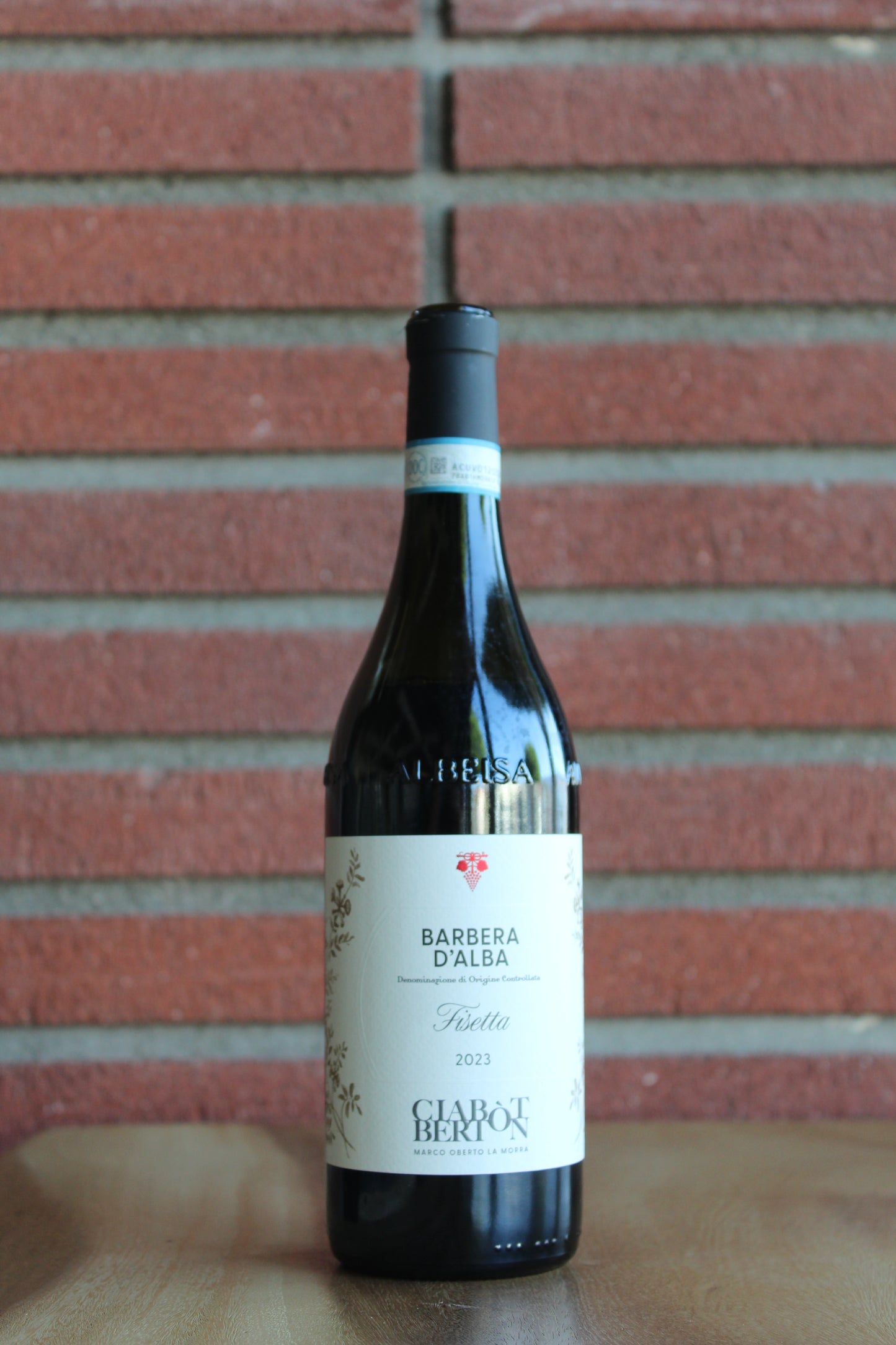
Ciabot Berton "Fisetta" Barbera d'Alba 2023
Ciabot Berton "Fisetta" Barbera d'Alba 2023
La Morra, Alba, Piedmont, Italy
Couldn't load pickup availability
Share
-
Tasting Notes
Bright cherry and ripe strawberry mingle with fresh basil, black pepper, and a whisper of smoky earth on the nose. The palate is juicy and generous, bursting with rich cherry and plum flavors that unfold into a rustic, slightly savory finish. Soft tannins provide gentle structure, while lively acidity keeps the wine fresh and balanced. There’s a subtle complexity here—an earthy, almost smoky undertone—that adds depth without sacrificing approachability.
This Barbera delivers satisfying weight and character, making it a versatile everyday wine. It stands up beautifully to tomato-based pasta, wood-fired pizza, grilled vegetables, and herb-roasted chicken. For those seeking a more lighter fruitier alternative to Pinot Noir, this Barbera offers both charm and substance. -
Story
A Legacy Rooted in the Langhe
In the hills of La Morra, surrounded by the rolling vineyards of Barolo country, Ciabot Berton is more than a winery—it is a family’s tribute to tradition, terroir, and the quiet beauty of a life lived close to the land.
The story begins in 1876, when Giovenale Viberti, great-grandfather to today’s winemakers, planted his first vines in the Rive cru. For decades, the family farmed with devotion, selling their fruit while nurturing a deepening bond with the soil and seasons. But in the late 1950s, a turning point came. Luigi Oberto, guided by passion and a desire to see his family’s work through to the glass, bottled his first wine. That 1961 Barolo marked not just a vintage, but the beginning of Ciabot Berton as we know it today.
Now, Luigi’s children Marco and Paola, alongside Marco’s wife Federica, carry the torch. With Marco’s oenological training, Paola’s hands-on vineyard knowledge, and Federica’s sommelier’s sensibility, the estate has grown into a deeply rooted, proudly artisanal operation. Their vineyards stretch across 12 hectares in some of La Morra’s most prized crus—Roggeri, San Biagio, Cappallotti, and others—each parcel vinified individually to honor its distinct voice.
But beyond the technical expertise lies something more personal. For the Oberto family, the winery isn’t just a business—it’s an extension of home. Their name, Ciabot Berton, reflects that. A ciabòt is a small vineyard hut (typical of the Piedmont region), and the one that still stands on their property once belonged to “Bertòn,” a local fireworks-maker whose final display famously blew the roof off the hut. That stone shelter, now overgrown with vines, is more than a namesake—it’s a symbol of memory, family, and a sense of place.
Oberto family says “It symbolizes home, family, an intimate place where we can cultivate beauty and share the small but significant pleasures of life.”
From vine to cellar, their approach is respectful and restrained—minimal intervention, maximum expression. The goal is never to manipulate the wine, but to let the land speak clearly, honestly, and beautifully.
-
Somm Notes
In Piedmont, Barbera is the people's grape—ubiquitous in vineyard and culture alike. As the most widely planted variety in the region, it plays a fundamentally different role from the more aristocratic Nebbiolo. Where Barolo and Barbaresco are wines of tension, tannin, and time, Barbera offers immediacy: vivid acidity, generous fruit, and supple texture. It’s less contemplative, more convivial—a wine meant to be opened and enjoyed, not revered from afar.
Barbera thrives throughout Piedmont, but two primary appellations shape its identity: Barbera d’Asti and Barbera d’Alba. In Asti, with its sandier soils and gentler contours, the wines tend to be more delicate—higher-toned, with lifted aromatics and a lighter frame. In contrast, Barbera d’Alba, particularly from hillside sites near La Morra and Monforte, takes on more depth and dimension, thanks to denser calcareous clay and marl, and greater elevation variance. Here, the grape can produce wines with real gravity—still bright and approachable, but undeniably more structured and grounded.
This wine hails from La Morra, a commune famed not only for its Barolo vineyards but also for its capacity to translate marl-rich soils and altitude into wines of purity and precision. While Nebbiolo may command the headlines, it’s Barbera that has long graced the tables of local families—paired not with pomp, but with homemade tajarin, braised meats, and seasonal delicacies like Alba’s prized white truffles.
Speaking of which, food pairings are where Barbera shines. Thanks to its naturally high acidity and low tannins, it’s incredibly food-versatile—cutting through richness, amplifying umami, and refreshing the palate bite after bite.
Recommended pairings include:
- Tajarin with butter and shaved white truffle (a local classic)
- Agnolotti del plin in sugo d’arrosto
- Porcini risotto or mushroom polenta
- Charcuterie, grilled pork, or roast chicken with herbs
Even upscale takes on comfort fare: eggplant parmesan, wood-fired pizza, or duck confit with cherry glaze
Barbera may not age for decades like its Nebbiolo counterparts, but its charm lies in its immediacy, drinkability, and its ability to elevate everyday moments into something quietly remarkable. -
Region
The town of Alba sits at the heart of the Langhe, a UNESCO World Heritage site celebrated for its rolling hills, medieval villages, and exceptional terroir. Unlike the broader Asti zone—where soils tend to be sandier and the landscape flatter—Alba’s terrain is more rugged, marked by calcareous marl, compacted clay-limestone, and varied elevations. These geologic layers, formed from ancient marine sediments, are ideal for crafting wines with structure, acidity, and age-worthiness. The region’s continental climate—with cold winters, hot summers, and wide diurnal shifts—prolongs the growing season, encouraging depth of flavor and aromatic complexity in the fruit.
One of the most distinctive communes within the Alba zone is La Morra, perched at some of the highest elevations in the Barolo DOCG (up to 500 meters). La Morra’s soils are primarily Tortonian in origin—rich in magnesium and manganese, finely textured, and more fertile than neighboring zones. These lighter, marl-based soils tend to yield wines that lean into elegance, aromatic finesse, and softer tannins. The altitude brings cooler temperatures and greater diurnal shifts, which preserves acidity and enhances aromatic lift. Vineyards here are often blanketed in morning fog and drenched in afternoon sun—ideal conditions for grapes to develop complexity while retaining balance.
La Morra stands apart not only for its geological profile but for its long-standing reputation as a cradle of quality. Its vineyard sites have been prized for centuries, and the commune continues to be a benchmark for refined, site-driven expressions of Piedmont’s potential.