

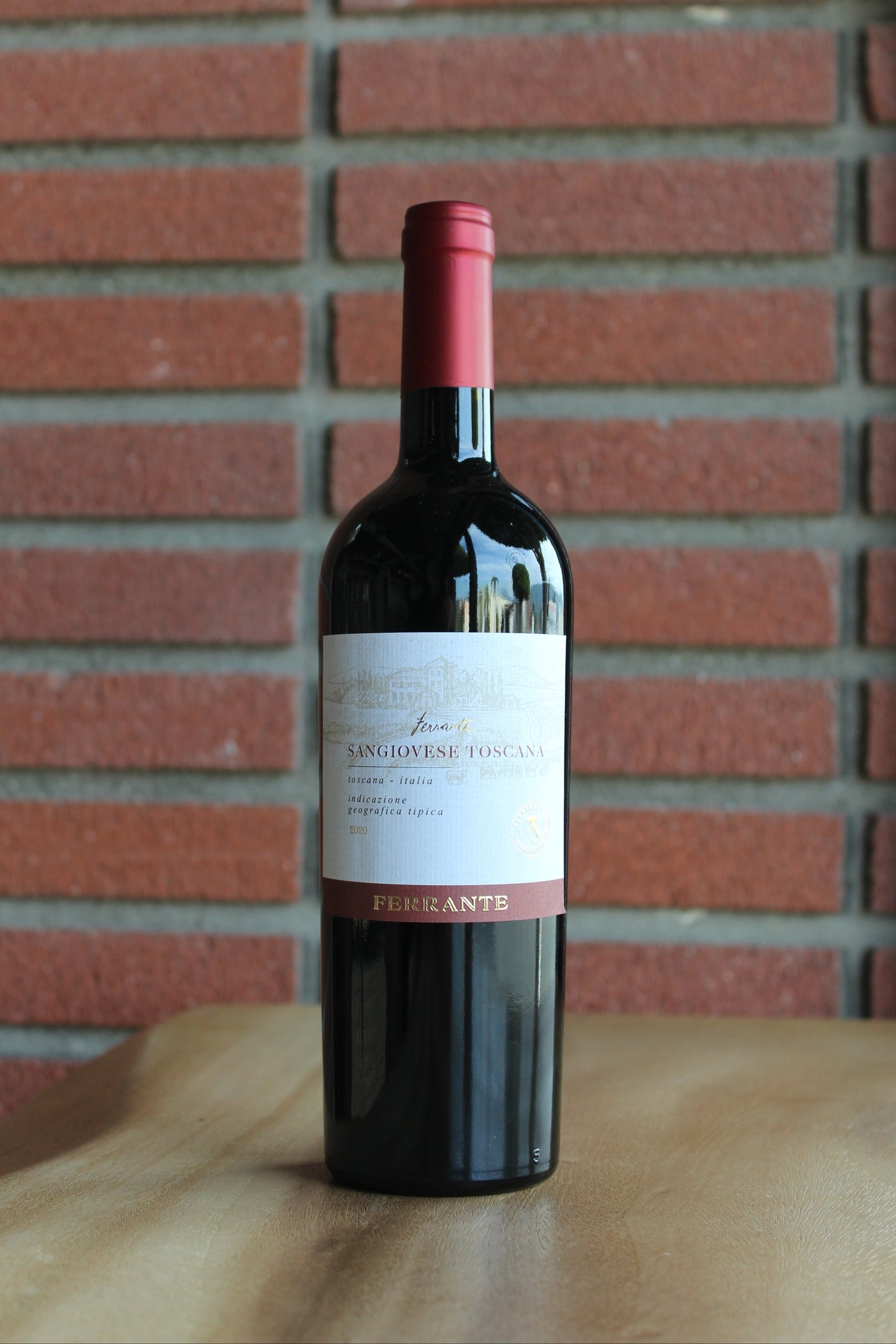
Ferrante Maxima Toscana Red Blend 2020
Ferrante Maxima Toscana Red Blend 2020
Tuscany, Italy
Couldn't load pickup availability
Share
-
Tasting Notes
The 2020 Ferrante Maxima Toscana leads with an inviting nose defined by a balance of ripe red and black fruits, accented by delicate floral notes of fresh lavender and dark violet. Unlike more herbal-forward Tuscan reds, the bouquet is noticeably softer and fruit-driven, complemented by a gentle, integrated touch of oak influence.
On the palate, this red blend—built on a classic core of Sangiovese and Canaiolo complemented by Cabernet Sauvignon and Syrah—delivers a deeper, more concentrated fruit profile filled with wild bramble, dark huckleberry, plum, and rich black cherry. It hits an ideal structural sweet spot: while remaining light and effortless to sip, it possesses more than enough body and velvety texture to hold your attention. The finish is smooth and clean, leaving a subtle hint of warm clove spice alongside lingering dark berry notes. Round, balanced, and immensely approachable, this is an undeniable crowd-pleaser that transitions seamlessly from solo sipping to the dinner table. -
Story
Four generations in the making, Ferrante is a cross-Atlantic story of heritage, homecoming, and old-world passion.
The journey began in the early 1900s when Ferrante Castellani left his hometown of Giuliano di Roma in Lazio, boarding a ship for New York. Passing through Ellis Island, he built a new life in America, grounding his family in values of hard work and deep respect for their Italian roots.
A century later, the story came full circle. Ferrante’s grandsons and great-grandsons returned to their ancestral homeland, joining forces with acclaimed Tuscan winemaker Piergiorgio Castellani. Known for his commitment to organic farming and chemical-free viticulture across historical estates in Tuscany, Piergiorgio brought decades of old-world winemaking authority to the partnership.
Together, they crafted Ferrante to bridge two worlds: honoring an Italian-American migration story while expressing the raw beauty, living soils, and unmanipulated terror of classic Tuscan winemaking for the modern table.
-
Somm Notes
The term "Super Tuscan" refers to a revolutionary category of high-end red wines born in Tuscany during the late 1960s and 1970s. At the time, Italy’s rigid appellation laws (the DOC/DOCG system) heavily restricted how traditional wines like Chianti could be made—often mandating the inclusion of white grapes or legally barring winemakers from using international varieties like Cabernet Sauvignon, Merlot, or Syrah.
Frustrated by these constraints, visionary producers chose to break the rules in pursuit of world-class quality. They began experimenting with French grape varieties, modern winemaking techniques, and aging in small French oak barriques. Because these bold, uncompromised blends did not conform to local laws, the Italian wine authorities stripped them of prestige, relegating them to the lowest legal tier: Vino da Tavola (simple table wine).
Despite the humble label, wine critics and global collectors quickly fell in love with their depth, structure, and opulence. Wine writer Burt Anderson is widely credited with coining the moniker "Super Tuscan" to describe the phenomenon. To accommodate their massive commercial success and exceptional quality, the Italian government eventually introduced the Toscana IGT classification, giving winemakers the freedom to innovate without losing their regional identity.
Today, the category spans everything from Bordeaux-dominant powerhouses to Sangiovese-forward icons. Notable benchmark brands that defined the movement include:
- Sassicaia (Tenuta San Guido): The pioneering Cabernet-based wine that started it all in Bolgheri.
- Tignanello (Marchesi Antinori): The legendary label that proved Sangiovese could be elevated through French barriques and innovative blending.
- Ornellaia & Masseto: Icons of coastal Maremma renowned for their lush, luxurious structure.
The Ferrante Maxima Toscana taps directly into this rich rebellious spirit, marrying traditional Tuscan character with modern, velvety approachability. -
Region
Tuscany’s legendary wine country is defined by a sun-drenched Mediterranean climate balanced by dramatic diurnal temperature shifts. Warm, bright days allow red grapes to develop deep sugar concentration and ripe, expressive fruit profiles, while crisp, cool nights slow down ripening, preserving essential acidity and fresh aromatics. The region’s varied soil matrix—dominated by clay-rich loam, limestone, and ancient marine sediment—forces vine roots to dig deep for nutrients, imparting a distinct savory undertone and structured minerality to the finished wines.
While Tuscany at large spans broad coastal plains and flat agricultural valleys, the region’s finest wines are born in its rolling inland hills. Flat valley floors tend to retain heat and moisture, producing heavier, less complex fruit; in contrast, high-elevation hillside vineyards benefit from superior sun exposure, constant air drainage that wards off vine disease, and dramatic thermal swings. These hillside microclimates allow Sangiovese and Syrah to achieve perfect phenolic ripeness while retaining the tension, elegance, and bright acidity that separate standard table wines from truly exceptional Tuscan reds.