

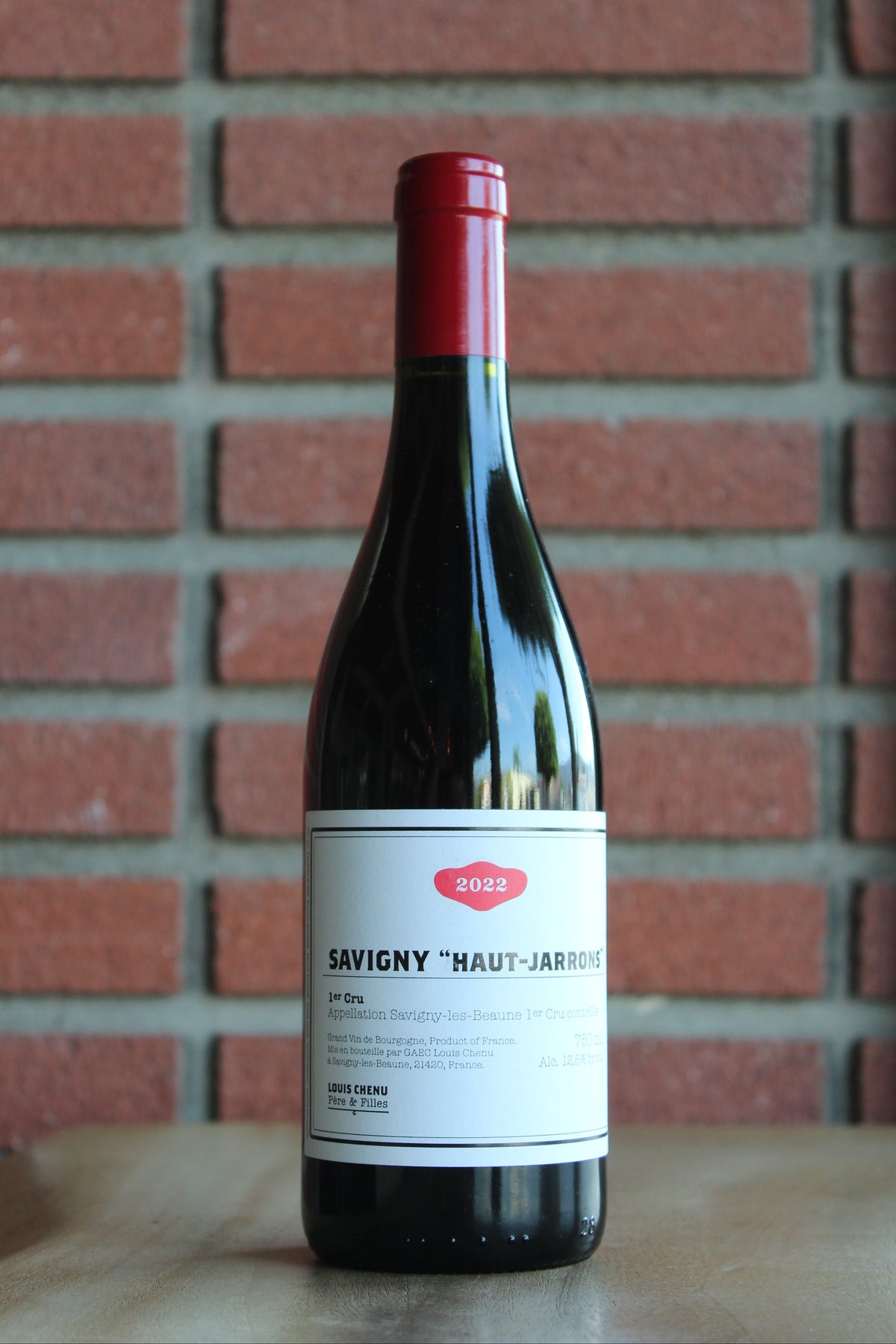
Domaine Louis Chenu Père & Filles Savigny-lès-Beaune 1er Cru "Les Hauts-Jarrons" 2022
Domaine Louis Chenu Père & Filles Savigny-lès-Beaune 1er Cru "Les Hauts-Jarrons" 2022
"Les Haut-Jarrons" 1er, Savigny-lès-Beaune, Burgundy, France
Couldn't load pickup availability
Share
-
Tasting Notes
The 2022 Domaine Louis Chenu Père & Filles Savigny-lès-Beaune 1er Cru "Les Hauts-Jarrons" immediately establishes itself as a wine of notable depth and grave quiet power. On the nose, it opens with an invitingly savory, earthy bouquet. Lifted accents of crushed wild berries and dark red cherries are layered against a grounding backdrop of soft, wet forest floor, damp moss, and a subtle crushed-rock minerality. Rather than leaning into bright, simple fruit, the aromatics lead with a rich, woodsy complexity that reflects both its old-vine heritage and the site’s gravelly clay soils.
On the palate, the wine delivers a bold, deep, and satisfying profile that fills the mouth without ever feeling heavy-handed. Dark forest fruits, bramble, and savory spice are wrapped in plush, supple tannins that lend a velvety structure to the mid-palate. There is a rich, tactile earthiness here—a impression of rain-soaked woodland—that gives the core of fruit a distinctly serious, muscular edge while staying true to the Chenu sisters' signature fresh, low-intervention winemaking style.
The finish is long, harmonious, and decidedly savory, leaving a lingering impression of dark cherries, dried herbs, and wet stone earth. Beautifully balanced by a vibrant pulse of natural acidity, this 2022 Premier Cru strikes a balance between approachable, velvety depth today and the structural integrity needed to evolve gracefully over the next decade in the cellar. -
Story
Nestled in the historic village of Savigny-lès-Beaune, Domaine Louis Chenu Père & Filles is a fifth-generation family estate defined by continuity, precision, and an unshakeable connection to the Côte d’Or. The story began in 1914 with the purchase of a single Premier Cru plot in Les Lavières. For nearly a century, the family farmed their land quietly behind the scenes, selling grape must and barrels to Burgundy’s traditional négociants. Today, the estate spans 9.5 hectares and is stewarded by sisters Juliette and Caroline Chenu, who returned home in the 2000s to modernize their legacy, transitioning the domaine to full estate bottling and leading it into a vibrant new era.
At the heart of the sisters' approach is an uncompromising commitment to organic stewardship. Recognizing that high-yielding vines and heavy cellar intervention mask the soul of Burgundy’s terroir, Caroline and Juliette converted the vineyard holdings to certified organic farming in 2006. Working predominantly with old vines, many ranging between 40 and 80 years in age, they prioritize soil health, biodiversity, and gentle farming. The naturally restricted yields from these venerable vines deliver concentrated fruit with bright, unforced natural acidity, capturing the precise personality of Savigny’s unique micro-climats.
In the cellar, the winemaking is minimalist, designed to highlight aromatic purity, silky texture, and drinkability rather than heavy extraction. Red grapes are hand-harvested, gently destemmed, and fermented using native yeasts, relying on gentle foot-treading (pigeage) to extract delicate color and supple tannins. After aging up to 18 months in neutral French oak, the wines are bottled with minimal sulfur, preserving their lifted floral aromatics and red-fruit freshness. The result is an expressive, transparent house style that honors five generations of family history while offering a modern, elegant lens into the heart of Burgundy.
-
Somm Notes
Unlike Bordeaux, which ranks individual châteaux or brands, Burgundy classifies the land itself. Centuries of monastic observations established a strictly regulated four-tiered quality pyramid based entirely on geography:
- Regional (Bourgogne): Broad entry tier accounting for roughly 52% of total production.
- Village: Named for a specific commune (e.g., Savigny-lès-Beaune), representing about 37% of production.
- Premier Cru (1er Cru): Elite, specific vineyard plots (climats) that make up just 10% of Burgundy's output.
- Grand Cru: The absolute pinnacle—comprising roughly 1% across only 33 legendary vineyards.
Reading a Premier Cru label follows a distinct formula: [Village Name] + [Premier Cru / 1er Cru] + [Vineyard Name] (e.g., Savigny-lès-Beaune 1er Cru "Aux Serpentières"). Out of more than 1,200 vineyard plots in Burgundy, roughly 600 hold Premier Cru distinction. These sites occupy the geographic "sweet spot" of the hillside—mid-slope microclimates where precise elevation, ideal sun exposure, and targeted limestone-and-clay drainage converge to cultivate grapes with exceptional depth and complexity.
Because these Premier Cru microclimates are strictly bounded by history and law, their yields are naturally finite. Stepping up to a Premier Cru means tapping into the top 10% of Burgundy's terroir—and in a village like Savigny-lès-Beaune, which has no Grand Crus, these Premier Cru sites represent the absolute highest expression of the village's soil, structure, and aging potential.92 points - Vinous
“The 2022 Savigny-lès-Beaune Haut-Jarrons 1er Cru has a fragrant bouquet with pressed flowers infusing the vivacious red fruit with an underlying marine influence that becomes more pronounced with aeration. The palate is medium-bodied with pliant tannins and a fine bead of acidity. It's harmonious and poised, with a gentle grip on the finish. Real delicacy here.” - Neal Martin (Vinous) -
Region
Savigny-lès-Beaune
Tucked slightly back from the main valley floor along the Rhoin stream, Savigny-lès-Beaune occupies a unique ecological sweet spot within the Côte de Beaune, the southern half of Burgundy’s iconic Côte d’Or escarpment. Framed by the slope of Mont Battois to the south and the majestic hill of Corton to the north, the village sits between power and finesse. While neighboring appellations like Pommard and Aloxe-Corton are known for denser, more muscular expressions of Pinot Noir, Savigny’s distinct position within a lateral valley allows it to craft wines celebrated for their perfume, agility, and supple texture.
This singular microclimate earned Savigny-lès-Beaune its own official Appellation d'Origine Protégée (AOP) in 1937. The village’s vineyards are split across two opposing hillsides facing each other across the Rhoin, creating a dynamic interplay of exposures. South-facing slopes absorb generous sunlight to ensure full phenolic ripeness, while north-facing slopes catch cool breezes channeled down from the forested combes of the Hautes-Côtes. This natural air movement acts as a cooling system, preserving bright red-fruit purity and crisp, natural acidity even in warmer vintages. Paired with a complex geological landscape—ranging from gravelly, high-elevation limestone to iron-rich alluvial clay on the lower slopes—Savigny delivers a terroir-driven style that is unmistakably its own.
Les Hauts-Jarrons
Positioned on the mid-slope of Mont Battois near the border of Beaune, Les Hauts-Jarrons is one of Savigny-lès-Beaune’s most distinguished Premier Cru sites. The secret to its prestige lies in its unique geology and ideal elevation. While much of Savigny is celebrated for lighter, ethereal Pinot Noir, Les Hauts-Jarrons features deeper, gravelly clay soils sitting over hard limestone—a soil profile remarkably similar to top sites in neighboring Beaune. Blessed with optimal drainage, full solar exposure, and old vines whose deep roots pierce through the topsoil into the bedrock, this climat consistently achieves complete phenolic ripeness while drawing a distinct mineral drive from below.
It was granted Premier Cru status precisely because it offers a level of structural depth, concentration, and longevity rarely matched at the village level. Bridging the gap between Savigny’s signature floral elegance and Beaune’s broader, more muscular weight, the wine shows a firmer tannic architecture and a darker fruit profile dominated by black cherry, wild bramble, and earthy spices. Tightly wound in its youth, Les Hauts-Jarrons rewards patient cellaring, blossoming over a decade or more into a deeply complex, age-worthy expression of Burgundy Pinot Noir.