

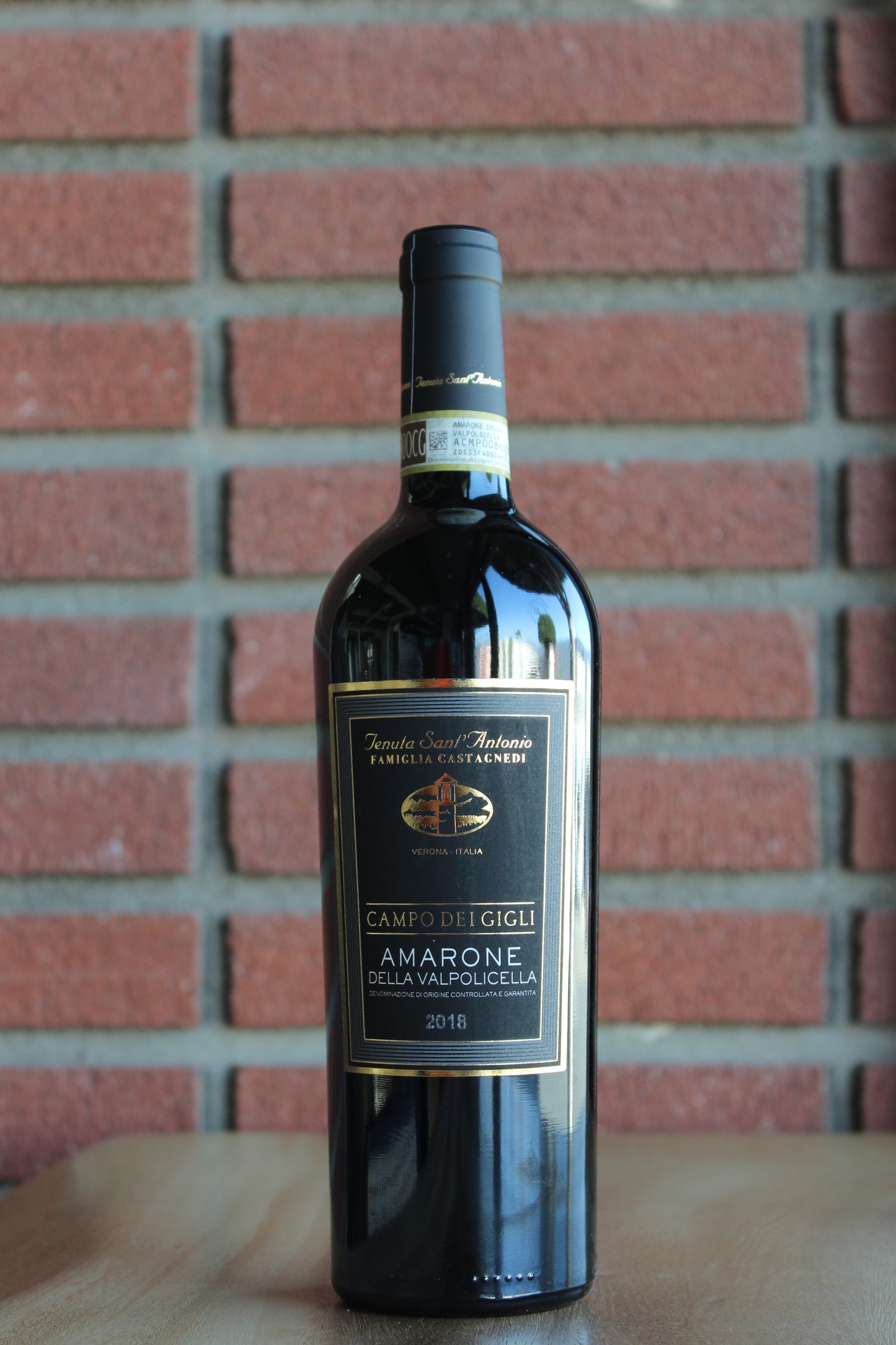
Tenuta Sant’Antonio Campo dei Gigli Amarone 2018 | Valpolicella DOCG Single-Vineyard
Tenuta Sant’Antonio Campo dei Gigli Amarone 2018 | Valpolicella DOCG Single-Vineyard
Valpolicella, Veneto, Italy
Couldn't load pickup availability
Share
-
Tasting Notes
This 2018 Campo dei Gigli - "Field of Lilies" - pours a deep ruby‑garnet and immediately delivers a bold, layered nose. Aromas of vanilla bean, sweet clove, baking spice, and lightly toasted tobacco leaf mingle with soft, almost candied red fruits — cherry, raspberry, and hints of cherry syrup — and subtle notes of dark chocolate and cocoa. There’s even a whisper of cherry-soaked pie crust, giving a warm, inviting impression.
On the palate, the wine is rich and bold yet silky smooth, with soft, polished tannins that carry concentrated flavors of black and red cherries, chocolate, vanilla, and spice. The mid-palate shows depth and complexity, echoing aromas of tobacco and a hint of earthy minerality, while the finish is long and resonant, leaving a lasting impression of sweet spice, dark fruit, and a refined, lingering richness. This Amarone balances generosity with elegance — approachable now but ready to evolve beautifully over the next 5–10 years. -
Story
Tenuta Sant’Antonio may be a relatively young name in the world of Valpolicella, but its roots run deep. Founded by the four Castagnedi brothers — Armando, Tiziano, Massimo, and Paolo — the estate was born from generations of family farming and a shared vision to craft wines that reflect both their land and their legacy. The brothers grew up tending their father’s vineyards in Colognola ai Colli before purchasing additional hillside land in Monti Garbi, where limestone soils and cooling breezes offered the perfect foundation for balance and elegance in wine. Their first vintage in 1995 marked the start of a new era for Valpolicella: one defined by precision, purity, and a respect for both innovation and tradition.
Today, Tenuta Sant’Antonio is celebrated for its vineyard-first approach and its dedication to single-site expression. The family farms across Soave and Valpolicella, producing wines that capture each region’s unique character while maintaining a house style known for finesse and freshness. Their flagship Amarone, Campo dei Gigli, hails from an elevated, terraced vineyard that delivers remarkable concentration and minerality — a benchmark for modern Amarone. Beyond their wines, the Castagnedi brothers have become champions of sustainable viticulture and thoughtful production, incorporating organic practices and minimal intervention in both vineyard and cellar. What began as a family dream has evolved into one of Veneto’s most respected estates, producing wines that speak fluently of place, patience, and passion.
-
Somm Notes
Tenuta Sant’Antonio isn’t just about crafting bold, elegant Amarone — the Castagnedi family is deeply committed to sustainable viticulture. Their vineyards are managed with careful attention to soil health, biodiversity, and natural balance, ensuring that every grape expresses the land’s character while supporting long-term ecological harmony. Minimal intervention in the cellar preserves the purity of fruit and the integrity of this single-vineyard expression.
Amarone della Valpolicella is made using the appassimento method, a hallmark of the region. After harvest, grapes — primarily Corvina, Corvinone, and Rondinella — are carefully sorted and laid on traditional bamboo racks (arele) in ventilated drying rooms for several months. This slow drying concentrates sugars, flavors, and tannins, producing the wine’s signature richness and depth while maintaining freshness. While many other respected producers — including Allegrini, Masi, and Bertani — also use appassimento, each estate adapts the method to their vineyard, vintage, and house style. By law, Amarone must age at least two years before release, with Riserva and single-vineyard selections often aged four years or longer to develop added complexity and structure.
When it comes to food pairing, this Amarone shines with hearty, flavorful dishes. Ideal matches include braised short ribs, osso buco, roasted duck, mushroom risotto, aged cheeses, or chocolate-dusted desserts. The wine’s natural acidity, silky tannins, and layered fruit make it versatile enough to elevate both classic Italian cuisine and bold modern pairings — perfect for gifting, a dinner party, or a special occasion.
Reviews:
95 points - Eric Guido, Vinous
Remarkably pretty, yet dark and intense, the 2018 Amarone della Valpolicella Campo dei Gigli bursts from the glass with dusty notes of dried roses, balsamic spice, tobacco, dark chocolate and dried black cherries. Seamless and elegant in style, this envelops the palate with ripe red and blue fruits, taking on a bitter tinge of mocha and espresso toward the close. It finishes long and staining, with a coating of fine-grained tannins that adds a classically dry impression while minty herbal tones maintain freshness. This transcends the 2018 vintage, yet patience will be required. -
Region
Stretching north of Verona between the Adige River and the Monti Lessini foothills, Valpolicella is a region of rolling vineyards, ancient stone terraces, and complex soils that tell a geological story millions of years in the making. This is Amarone country — where traditional grape varieties like Corvina, Corvinone, Rondinella, and Oseleta thrive under a combination of sunlight, elevation, and cooling mountain influence. The hillsides, rising from roughly 150 to 450 meters, enjoy a near-perfect balance of ripening heat by day and fresh, tempering breezes at night. Limestone, clay, and basaltic soils alternate across slopes, giving wines structure, minerality, and aromatic lift. These natural contrasts are what make Valpolicella’s wines — especially Amarone — both generous and graceful.
Within this landscape, the region divides into several subzones: the Classica area near Fumane, Negrar, and Marano, known for supple fruit and soft spice; the Valpantena valley, celebrated for its balance and silky texture; and the Eastern Valpolicella (Valpolicella Orientale), where limestone and volcanic soils yield wines of depth and precision. This eastern stretch is home to the commune of Mezzane di Sotto, where Tenuta Sant’Antonio’s Campo dei Gigli vineyard sits on a sun-drenched hillside surrounded by olive groves and woodland.
Mezzane di Sotto is one of the highest and most geologically diverse areas in the appellation. Its vineyards rest on light-colored marly limestone and pockets of ancient volcanic tuff — a rare combination that contributes both power and finesse. The slopes here are well-drained and steep, with excellent air circulation, protecting grapes during the long, slow drying process (known as appassimento) used for Amarone production. This terrain encourages smaller berries and thicker skins, resulting in wines with concentrated fruit, fine-grained tannins, and a signature mineral backbone.
The terroir of Mezzane di Sotto lends a distinctive stamp to Campo dei Gigli: layers of ripe black cherry and plum supported by graphite, cocoa, and herbal tones, balanced by remarkable freshness. While western Valpolicella wines often emphasize plush fruit, those from Mezzane express a cooler, more linear profile — elegance wrapped in intensity. It’s a terroir that rewards patience and precision, and one that perfectly matches the Castagnedi family’s philosophy of crafting Amarone with harmony, structure, and soul.