

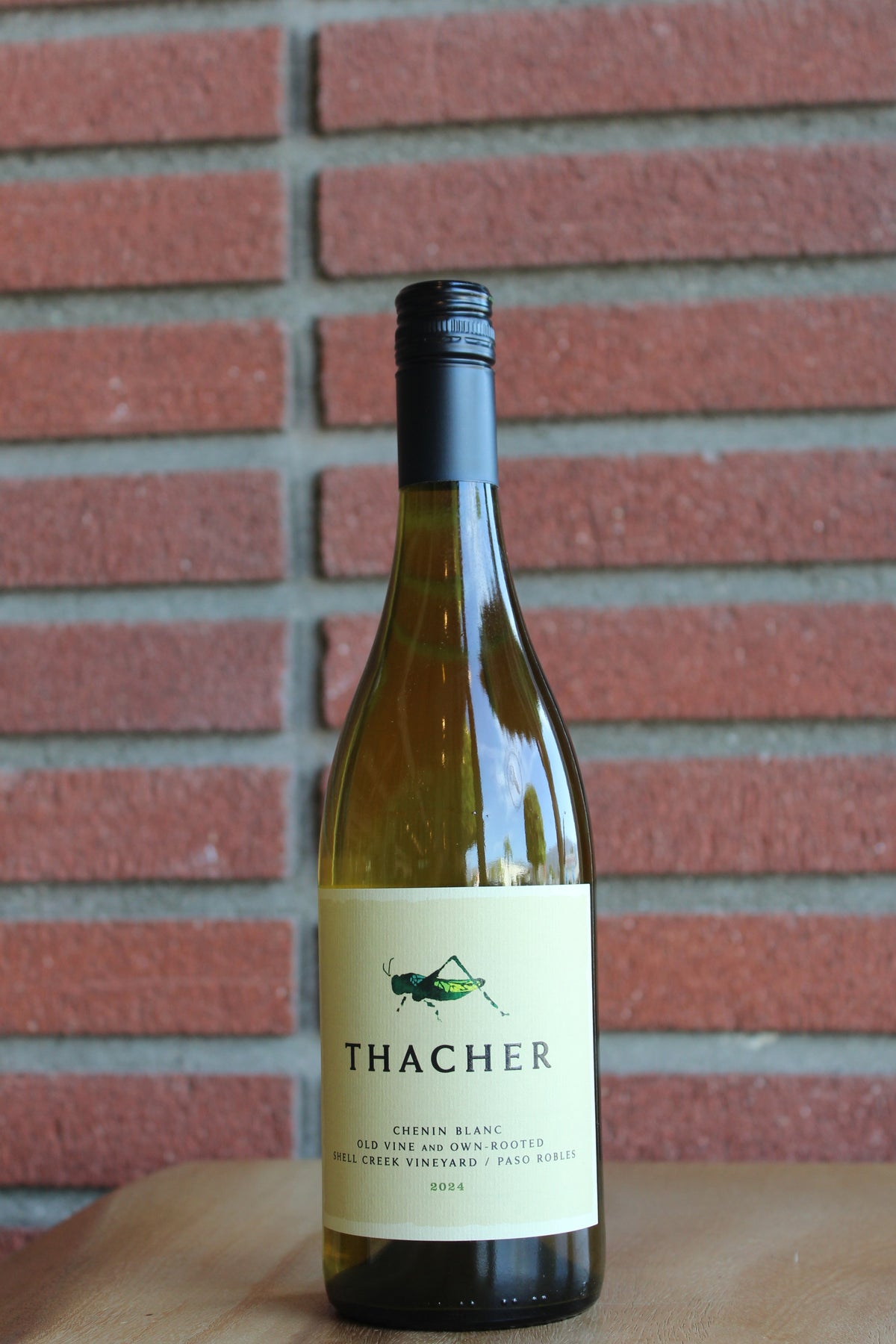
Thacher Own Rooted Chenin Blanc 2024
Thacher Own Rooted Chenin Blanc 2024
Shell Creek Vineyard, Highlands District, Paso Robles, California
Couldn't load pickup availability
Share
-
Tasting Notes
Floral aromas of honeysuckle, fresh pear, and honeydew melon open the nose, accented by a hint of banana and clean marine air. On the first sip, it hits the palate with the bright, mouth-watering crispness you might expect from a premium Pinot Grigio, but immediately builds with much more weight and flavor intensity. Vibrant layers of crisp lime, white peach, and green fig meet a soft orchard-fruit texture. As the wine carries across the palate, a savory, distinct herbaceousness emerges to add depth—reminiscent of the subtle herbal complexity found in a great Sauvignon Blanc. Everything ultimately resolves into a clean, wet-stone minerality that leaves a refreshing, saline-driven crunch on the finish.
The intense rocky minerality, savory herbaceousness, and structural "oomph" of this own-rooted Chenin Blanc make it an incredibly versatile companion at the dinner table. It pairs spectacularly with oysters on the half-shell or geoduck crudo, where the wine’s natural salinity mirrors the fresh ocean spray of the seafood. For a main course, its texturized body and bright acidity slice beautifully through richer dishes like wood-fired branzino stuffed with shaved fennel and citrus, pan-seared sea scallops in a light herb butter, or roasted chicken seasoned with rosemary and thyme. If you are leaning toward vegetarian options, it acts as a perfect foil for a savory spring pea risotto, grilled asparagus, or earthy roasted root vegetables. -
Story
Since 2004, Thacher Winery has been a beacon of handcrafted excellence in Paso Robles, showcasing the superb fruit of the Central Coast's vineyards. With a focus on small-lot productions, each bottle is a testament to the local subtleties and terroir that define the region. Today, their total production hovers around 5000 cases, all created with low intervention and native ferments, ensuring that each sip embodies the essence of the vineyard. Thacher Winery's mission is clear: to cultivate unique and food-friendly wines that captivate the senses and elevate any dining experience.
The story of Thacher Winery is one of passion and serendipity. Sherman, once an award-winning brewmaster in Southern California, and Michelle, a graduate of UCSB, found themselves drawn together in the heart of Paso Robles. It was during an evening of barrel sampling that they realized Paso Robles was where they truly belonged. After marrying in 1998 and welcoming three children into the world, the Thachers made the bold decision to leave Santa Cruz behind and embrace their destiny in Paso Robles. In July 2006, they made the move, and by 2008, Thacher Winery had opened its doors, marking the beginning of a new chapter in their family's journey. Today, Thacher Winery remains a testament to their shared vision and dedication, still family-owned and operated, continuing to craft exceptional wines that reflect the spirit of Paso Robles.
-
Somm Notes
Nearly all modern vineyards are grafted onto foreign rootstocks to protect them from root-destroying pests, meaning the roots below the ground and the vines above are actually two different plants fused together. Thacher’s Chenin Blanc is a rare, defiant exception. Planted in 1972 at Shell Creek Vineyard, these vines are completely own-rooted—growing on their own original root systems for over half a century. Without a surgical graft union to act as a speed bump or filter, there is a direct, completely uninterrupted pipeline from the deep marine-limestone soils of the Paso Robles Highlands District straight into the cluster. It is a pure, unadulterated translation of terroir that is increasingly difficult to find anywhere in the wine world.
For the wine drinker, this rare viticultural architecture changes everything about the structure in the glass. Because these old, own-rooted vines have dug deep into the earth and naturally self-regulate their crop, they don’t overproduce. Instead, they focus their energy into yielding small clusters with immense built-in balance, natural acidity, and deep phenolic concentration. This raw, direct connection to the soil is precisely what gives the 2024 vintage its hard-hitting rocky minerality and that incredible, texturized "oomph" on the palate—delivering a level of body, flavor power, and historical depth that a standard grafted vine simply cannot replicate.
94 points Wine Enthusiast
Slightly cloudy in the glass, this bottling from a dry-farmed, own-rooted vineyard that was planted more than a half-century ago never fails to impress. The nose combines a prominent rocky minerality with a lemony lift and a hint of nectarine. The palate hits hard with the stony quality before waves of stonefruit and Meyer lemon engage through the finish. — Matt Kettmann -
Region
In the southeastern corner of Paso Robles AVA lies the captivating winegrowing region of the Highlands District. Spanning over 60,300 acres, this area boasts a unique terroir shaped by its distinct soils and climatic conditions. The alluvial soils, featuring a blend of old leached alkaline soils and younger sandy soils along active streams, provide a fertile foundation for vineyards to thrive. Notably, French Camp Vineyard, one of the largest in Paso Robles, calls this district home, alongside other historic vineyards like Shell Creek and Shandon Hills. The region's elevation, ranging from 1,160 to 2,086 feet, coupled with its proximity to the Pacific Ocean, creates a microclimate characterized by significant diurnal temperature swings. This climatic phenomenon contributes to the development of grapes with robust flavor profiles, while retaining a refreshing natural acidity, making it ideal for cultivating exceptional varieties such as Petite Sirah, Syrah, Cabernet Sauvignon, Chenin Blanc, and Valdiguie.
The Highlands District's landscape is as diverse as its wines, encompassing vast expanses of grasslands, high ridges adorned with scattered pine trees, and lower hills dissected by canyons and arroyos. Despite its arid climate, the region benefits from the double rain shadow effect created by the nearby Santa Lucia and La Panza ranges, resulting in less precipitation compared to neighboring areas. The soils, predominantly sandy loam and clay loams, with subsoils cemented by calcium carbonate, present both challenges and opportunities for viticulture. While vines may initially struggle in these conditions, the resulting struggle enhances vine vigor and yields intensely rich fruit after the first 5-10 years. With warm summer days tempered by cool evening breezes, the Highlands District offers an ideal environment for grape cultivation, producing wines of exceptional quality and complexity that reflect the unique characteristics of this distinctive terroir.